On October 29, Mistral released the weights of Mistral Large 4, its biggest model: one trillion parameters (a trillion in English), multimodal, with a one-million-token context window, under a license that lets you use it, modify it and sell it, with one important exception. It's the upgraded version of the model the French company previewed earlier this month, and Mistral itself nicknames it "Le Chonk". For anyone building agents, bots or coding tools, the news has two sides: there is an open Western model that competes in programming, but running it at home is still something very few people can do.
What Mistral published
According to the model card on Hugging Face, Mistral Large 4 is a "granular" Mixture-of-Experts (MoE): about 1T total parameters, but only around 52 billion active per token (49 billion if you don't count the embedding and output layers). It has 128 routed experts, 4 of which are activated per token, plus one shared expert. The official documentation specifies 1.05T total parameters and a 1.6-billion-parameter vision encoder.
The rest of what the model card announces:
- 1M-token context.
- Text and image input, text-only output.
- More than 160 languages, including all the official languages of the European Union.
- Native function calling, JSON output and strict JSON schemas.
- Three reasoning levels per request:
low,mediumandhigh(the default). Thelowmode replaces the old no-reasoning mode. - Trained from scratch on 3,800 NVIDIA Grace Blackwell GPUs, in Mistral's own data centers in Europe.
The repository also includes an NVFP4 quantized version designed for Blackwell GPUs, which according to Mistral takes up less memory while keeping the same performance.
What the numbers say (Mistral's numbers)
All the figures in this section come from Mistral's announcement and I haven't verified them independently. The company says three more weeks of reinforcement learning after the preview put it at the front of open models in programming:
| Test | Result reported by Mistral |
|---|---|
| FrontierCode 2.0 (Cognition, private) | 19.7%, first place among the models evaluated |
| Artificial Analysis Coding Agent Index | 48%, tied with GLM-5.3 and with 47% fewer tokens per task |
| Terminal-Bench 4.0 | 41%, 13 points more than in the preview and 30% fewer output tokens |
| Artificial Analysis Cyber Index | 51% |
| B3 (agent resistance to attacks) | 97.1%, versus 93.3% in the preview |
| BrowseComp (web browsing) | 84.5% |
In blind evaluations by Surge, again according to Mistral, programmers preferred its code over that of GLM-5.3, Kimi K3 and DeepSeek V4.1 Flash, and it only trailed Claude Opus 5.5.
The important nuance is in the Hugging Face model card itself: on the Artificial Analysis general intelligence index (v5), Mistral Large 4 scores 26 points, "the highest among Western open models", but Mistral admits that the best Chinese open models score higher. In other words, it's not the best open model in the world overall; it's the best on its side of the map, with particular strength in code and cybersecurity.
Can you run it on your machine?
Short and straight: almost certainly not. The official vLLM recipe serves the model with --tensor-parallel-size 8, meaning it's split across eight data-center GPUs.
The home-brew route is the Unsloth quantizations; Unsloth had early access. According to their documentation, the full FP8 weights come in at around 1.1 TB; their 2-bit dynamic version at about 378 GB; and the 1-bit one (UD-IQ1_S) at about 233 GB on disk, just enough for a machine with 256 GB of memory, like a Mac Studio or two NVIDIA DGX Sparks. Unsloth claims that the 1-bit version keeps 91% of top-1 accuracy.
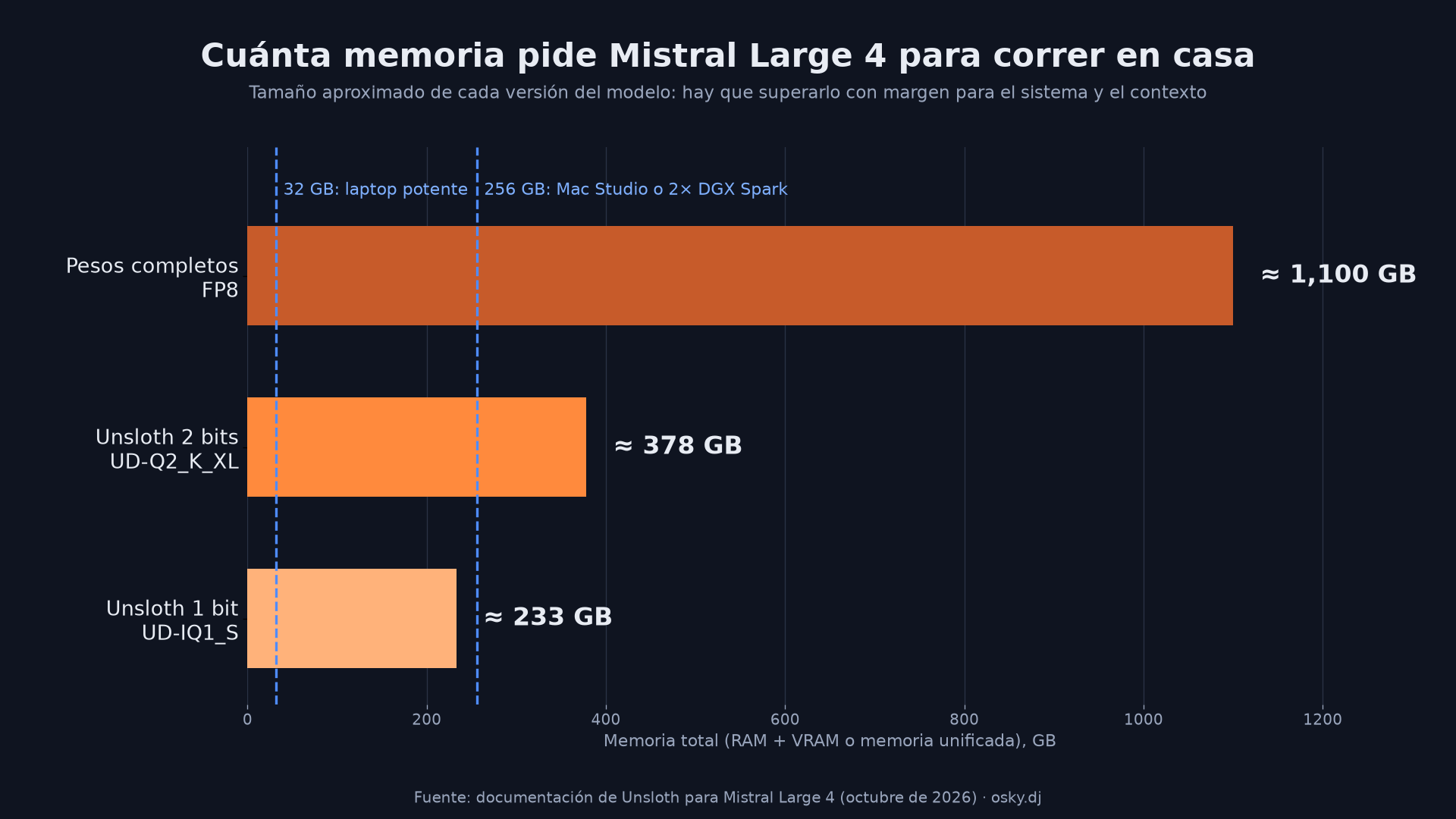
My take: for 99% of developers, "open weights" here means being able to choose your provider, not running it on your laptop. And that's no small thing.
Where to use it and how much it costs
Mistral offers it in its API as mistral-large-4, in Mistral Studio, on OpenRouter and in its coding agent Vibe. Microsoft Foundry is the first cloud to offer it as a managed service, and NVIDIA has it on its endpoints and as a NIM container. To serve it yourself there's support in vLLM (the recommended one), SGLang, Transformers and llama.cpp, and for fine-tuning, in Axolotl, Unsloth and TRL.
The price on Mistral's API is $0.70 per million input tokens, $0.07 per million cached input tokens and $2.10 per million output tokens. In the Hacker News thread, which passed 1,600 points, there was discussion about how that price compares with the preview's and with cheaper Chinese models like DeepSeek V4.1 Flash; several users still considered it expensive for what it delivers.
The license's fine print
Here's what matters most to anyone building products. Mistral Large 4 uses the Mistral Ecosystem Open-Weight License, a modified version of the MIT license. It allows you to use, copy, modify, fine-tune, distribute and sell the model and its derivatives, with one condition: if you or your company operate a "Model as a Service" business, you need a separate commercial license from Mistral before using it commercially.
The license defines that service as giving third parties access to the model for inference or training "with significant control over the inputs, parameters or data". And it expressly excludes end-user products where the model lives only inside specific features, the simple forwarding of requests to models hosted by others, and internal use.
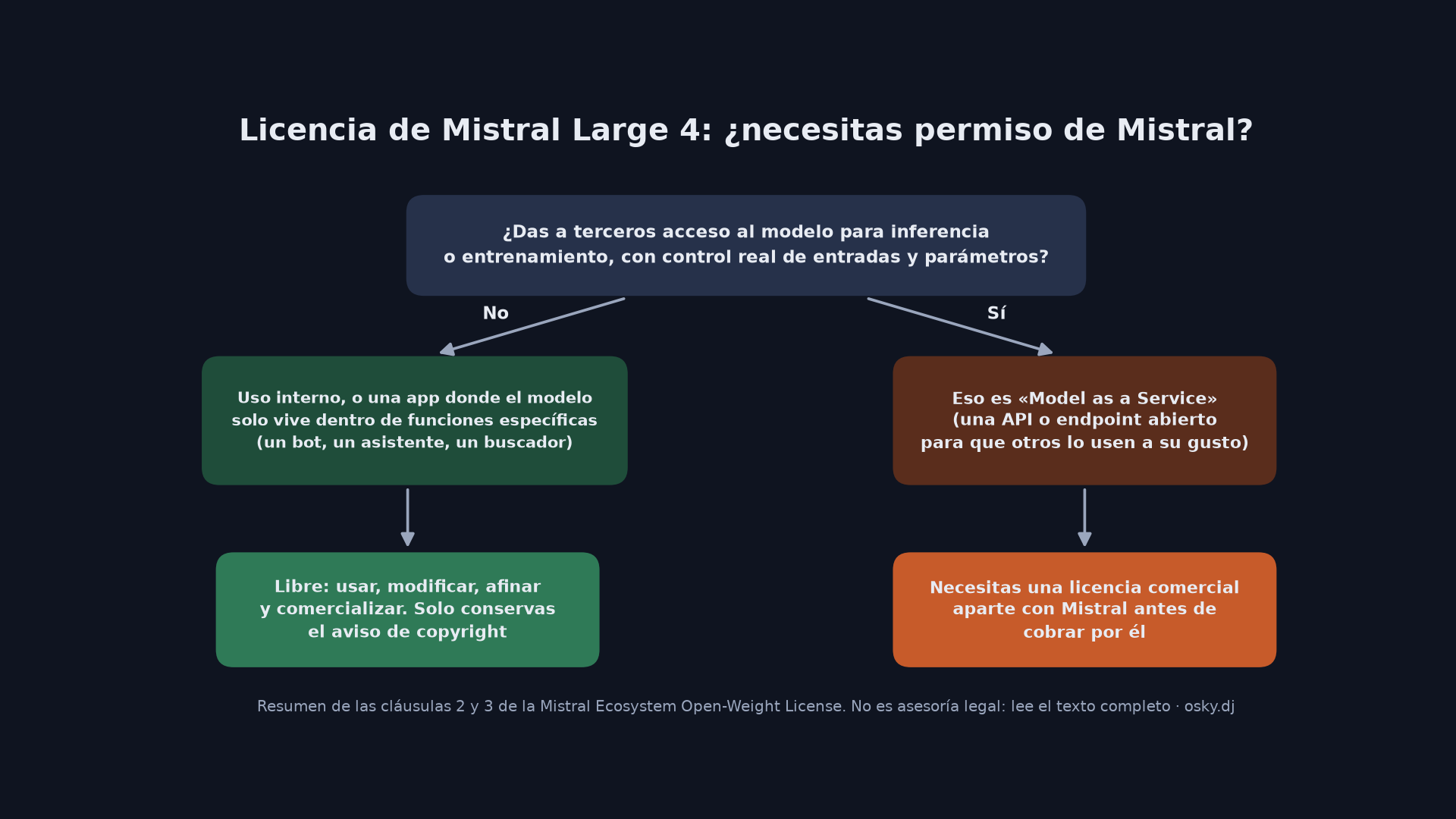
What this means in practice, according to my reading of the text (this is not legal advice): a WhatsApp customer service bot, an assistant inside a CRM or an internal search engine fall on the free side. Setting up an API to resell the model to other developers does not. That's why there was a semantic fight on Hacker News: under the OSI's definition of open source AI, this is not open source, and Mistral doesn't call it that either; it calls it open weight.
Cybersecurity: the bet and its asterisk
Mistral sells the model as a tool for defense teams: it says it reproduces and patches vulnerabilities without refusing legitimate tasks and that it rejects 96.6% of malicious requests, the highest figure it measures among open models. It also admits something unusual in an announcement: after monitoring the preview's traffic, it sees "potential" for the model to help carry out real attacks, so it is tightening its guardrails and will keep doing so. Verified partners like Orange Cyberdefense get access to a specialized variant for penetration testing.
On Hacker News, several commenters pointed out that those guardrails carry little weight in an open-weight model, because whoever hosts it can modify it. My take: the 96.6% measures the model's behavior as Mistral delivers it, not what anyone who downloads it can make it do.
What we still don't know
- How it behaves outside the tests Mistral chose: independent evaluations are just getting started.
- Whether the current price holds. On Hacker News someone pointed out that the rate changed several times during the preview.
- Which specialized models will come out of this base: Mistral says Large 4 will be the foundation of its next generation.