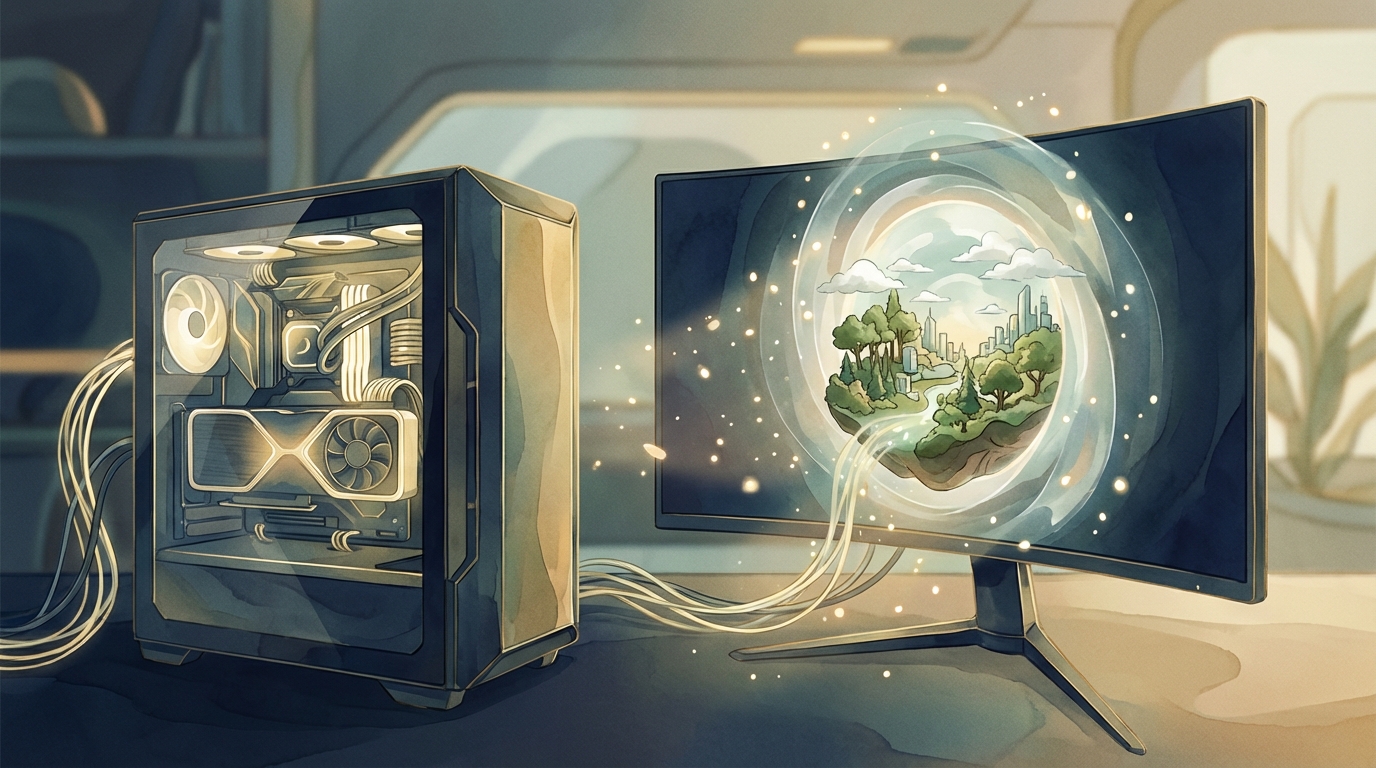
Waypoint-1.5 arrives with a promise that is actually worth taking seriously: bringing real-time generative worlds closer to the hardware people actually own, instead of leaving this entire category trapped inside spectacular demos that only exist because of extremely expensive infrastructure. According to the launch materials on Hugging Face and Overworld, the new version improves visual fidelity, environmental coherence, and accessibility, with two model tiers aimed at different scenarios, including a lighter variant designed for far more common consumer machines.
That detail changes more than it seems. In recent years, much of the hype around generative video and world models has been centered on the wow factor: how beautiful a frame looks, how cinematic a clip appears, or how convincing an environment feels for a few seconds. But there is a huge difference between watching a rendered scene and inhabiting a world that responds in real time, remains coherent as you move through it, and does not collapse the moment you step outside a tightly controlled demo path.
That is where Waypoint-1.5 seems to be aiming at the right problem. Instead of selling aesthetics alone, it pushes on two variables that matter much more for real product: latency and accessibility. If a model can run locally on machines closer to a gaming laptop or a reasonably strong desktop GPU, then it stops being just a lab curiosity and starts becoming relevant for interactive prototypes, creative tooling, simulation, immersive experiences, and even testing environments for autonomous agents.
Another important point is the scale of training. The team claims this version was trained on nearly one hundred times more data than Waypoint-1, and while that kind of number always deserves healthy skepticism, it does help explain the emphasis on temporal and environmental coherence. In world models, the challenge is not just generating a beautiful frame. The real challenge is sustaining a world while a user moves through it, making it respond immediately, and preventing each frame from feeling like a different reality improvised on the fly.
If that really improves, the implications go far beyond entertainment. A relatively accessible local world model could unlock new layers in spatial data visualization, operational training, process simulation, three-dimensional interfaces, and hybrid experiences sitting somewhere between game, tool, and workspace. It also gives independent developers more room to experiment without needing datacenter-scale budgets for every iteration.
Of course, there is still a gap between promise and usable product. Technologies like this often look spectacular in their own clips, but struggle under long sessions, unpredictable input, or less controlled interaction. The difference between “runs in real time” and “works as a stable foundation to build on” remains enormous. Even with that caution, however, the direction is a good one.
The most interesting thing about Waypoint-1.5 is not only that it looks better, but that it points toward a more mature idea of world models: not as automatic cinema, but as inhabitable interactive systems. If that transition holds on more accessible hardware, then we can start talking about a platform with real consequences, not just another beautiful demo built for social media applause.