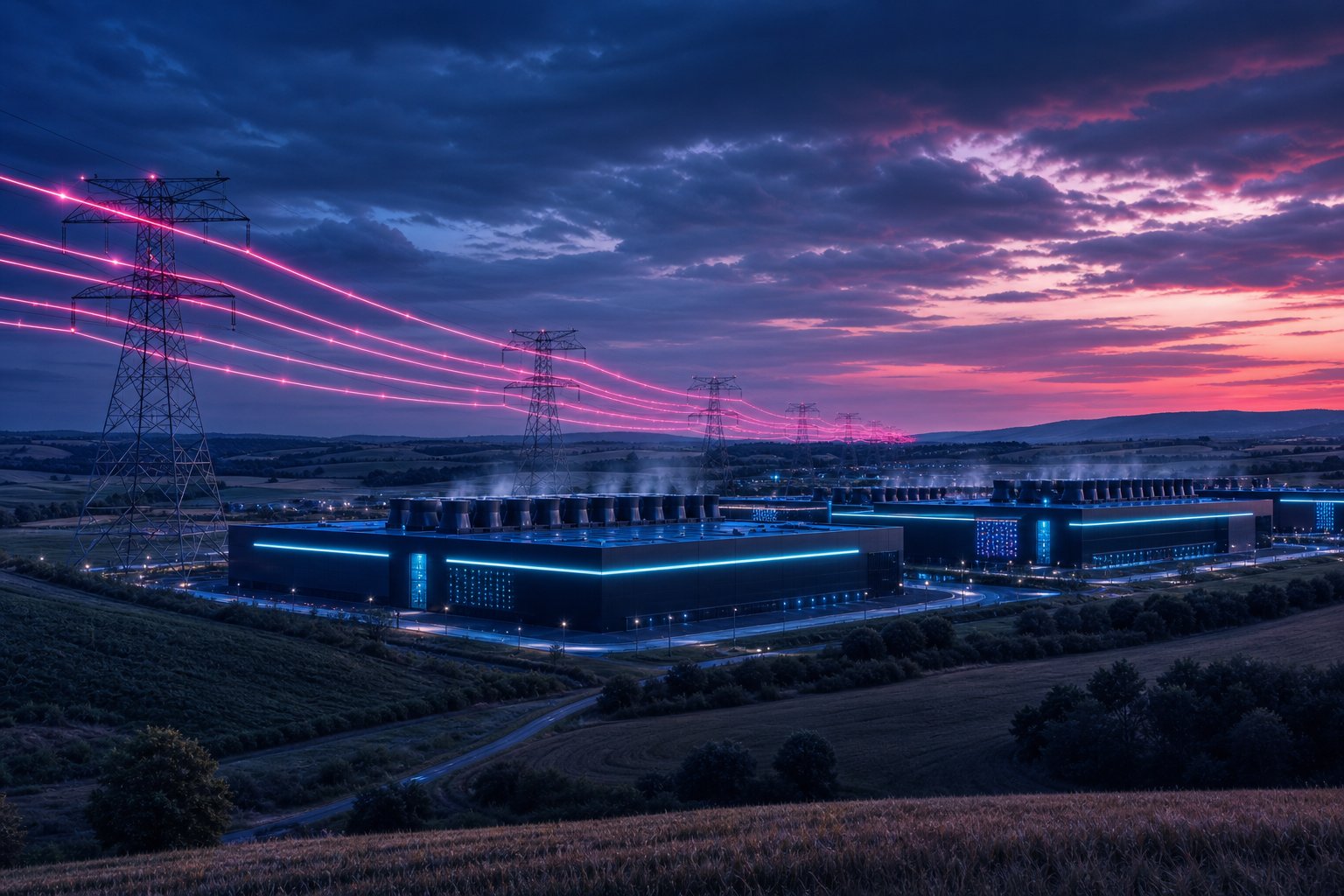
SoftBank has just announced an investment of up to €75 billion to build data centers in France, with the goal of developing and operating up to 5 gigawatts of additional capacity. To put that in perspective: 5 GW is roughly double what Mexico City consumes on a peak day. This is not a timid bet. It is a declaration of intent from the Japanese group, led by Masayoshi Son, that Europe — and France in particular — is one of the main boards where the control of artificial intelligence infrastructure will be decided over the next decade.

The question nobody asks in the headlines is: why France? The answer has several layers. First: energy. France generates around 70% of its electricity from nuclear power, making it one of the countries with the cheapest, most stable, and lowest-carbon electricity in all of Europe. For a data center at massive scale, the cost and predictability of power supply is not an operational detail — it is the variable that determines whether the business makes sense at all. Second: politics. President Macron has spent years trying to position France as Europe's technology hub, attracting capital with a combination of tax incentives, Europeanist rhetoric, and a "digital sovereignty" narrative that resonates with governments that do not want to depend exclusively on American or Chinese infrastructure. Third: timing. With the explosion in demand for compute to train and serve large language models, data center capacity in Europe is saturated. Whoever builds now collects rent in two or three years.
The SoftBank context: from WeWork to AI, with a detour through embarrassment
SoftBank has a peculiar history with big bets. Its Vision Fund I lost epic sums on WeWork, Uber, and dozens of startups that promised to "disrupt" industries and ended up disrupting themselves. But Son learned — or at least adjusted the pitch — and since 2023 has pivoted aggressively toward AI infrastructure. The logic is different: instead of betting on a particular startup winning the market, SoftBank is betting on being the landlord. It does not matter which AI model wins; it needs compute. And if that compute sits in a data center SoftBank operates, SoftBank wins regardless.
This "infrastructure as an agnostic bet" strategy is exactly what explains moves like Stargate in the United States — the $500 billion AI infrastructure project SoftBank leads alongside OpenAI, Oracle, and others — and now this announcement in France. Son is not betting on a horse; he is buying the racetrack.
5 gigawatts: what it means in practice
Five gigawatts of data center capacity does not get built overnight. Analysts estimate a project of this scale requires between five and eight years to be fully operational, assuming no bottlenecks in the supply chain for transformers, cooling systems, or construction permits — and there are always bottlenecks. The interesting part is that SoftBank says "up to" €75 billion, suggesting the deployment will be progressive and probably tied to real demand milestones. They are not going to build 5 GW into a vacuum; they will build as contracts arrive from hyperscalers, governments, or companies that need sovereign European compute.
In terms of magnitude: Microsoft announced $3.3 billion for France in 2024. Google has committed similar figures. SoftBank's bet makes them look small on paper, though execution is another matter entirely.
The angle that matters most for Mexico and Latin America
This news has direct relevance for the region even if it does not appear to. The concentration of AI infrastructure investment in Europe and the United States widens the gap in latency, cost, and access for Latin American companies that want to use frontier AI services. Every data center built in Paris or Virginia is a data center not being built in Monterrey, Bogotá, or São Paulo. The digital sovereignty Macron sells for France is exactly what Mexico does not have — and as long as global capital keeps betting on the global north, that asymmetry deepens.
For those of us working in technology from Mexico, the message is uncomfortable but clear: the infrastructure that will run the near-future AI is being decided right now, in negotiations between European governments and Japanese funds. We remain consumers of that infrastructure, not builders. That has consequences in price, latency, regulatory dependency, and who holds whose data.
The physical layer of AI geopolitics
SoftBank's investment in France is a business story. It is also a reminder that the geopolitics of AI plays out in very concrete physical layers: cables, cooling systems, transformers, and construction permits. The companies and countries that control those layers control the terms on which everyone else accesses artificial intelligence. That includes access speed, pricing power, data residency rules, and the ability to cut off service for political reasons — something that sounds paranoid until it happens.
The race to build AI infrastructure in Europe is not just about tech companies chasing margins. It is about governments deciding they do not want their critical AI workloads running on servers they do not control, in jurisdictions whose laws they cannot influence. France understood that early. SoftBank is happy to supply the concrete and the cooling towers, and to make a very large return on capital while doing so.

In that game, Mexico is still in the stands. The SoftBank announcement is a reminder of how much ground there is to cover — and how fast the window to build sovereign infrastructure is closing.