U.S. Internet (USI), a Minnesota internet provider, and Securence, its cloud email security and management division, are going to shut down nearly all of their hosted services on November 11, 2026. POP/IMAP email and webmail, Hosted Exchange, email filtering, archiving, authoritative DNS, domain registration, web and FTP hosting, and managed firewalls are all going away. Nothing migrates on its own. If you manage a domain that depends on them or you send email to their users, you have ten days to get moving.
On the official FAQ page for the shutdown, USI explains the reason with a single sentence it repeats for every service: it is simplifying its portfolio "to focus on fiber internet, voice, and network connectivity." Al Iverson, of Spam Resource, was the one who raised the alarm for the email world: according to him, USI was acquired by T-Mobile in 2025, and he suspects that telecom companies are no longer interested in the hosted email business.
What exactly is being shut down
According to the official FAQ, this is what stops working on November 11:
- POP/IMAP and webmail: you will no longer be able to read, send, or receive email via POP(S), IMAP(S), or webmail. Authenticated SMTP is also being shut down.
- Hosted Exchange: inbound and outbound messages will no longer be accepted, journaling stops, and the administration portal disappears.
- Securence filtering: it stops accepting inbound and outbound email, including the smarthost and SMTP relay. USI warns that, if you don't migrate, "this will interrupt your email services."
- Archiving: the archive will no longer be accessible. Anyone who needs their archived emails has to request the export from support; it is delivered as .EML files compressed and encrypted with 7z.
- Authoritative DNS: USI's servers will stop answering queries and domains that haven't been moved "will become unresolvable." That takes down the website and also the MX records.
- Domain registration: renewals, transfers, and changes to nameservers and DNSSEC all end. Here USI clarifies that the domain won't go down immediately, but without transferring it you won't be able to renew it or change anything.
The only extension I found in the FAQ: links rewritten by URL Shield, Securence's click-time link scanning, will keep working until December 31, 2026.
The consumer domains that are disappearing
For residential users, the blow is more direct. Addresses on USI's own domains cannot be kept: you have to open a new account with another provider. The FAQ lists these domains:
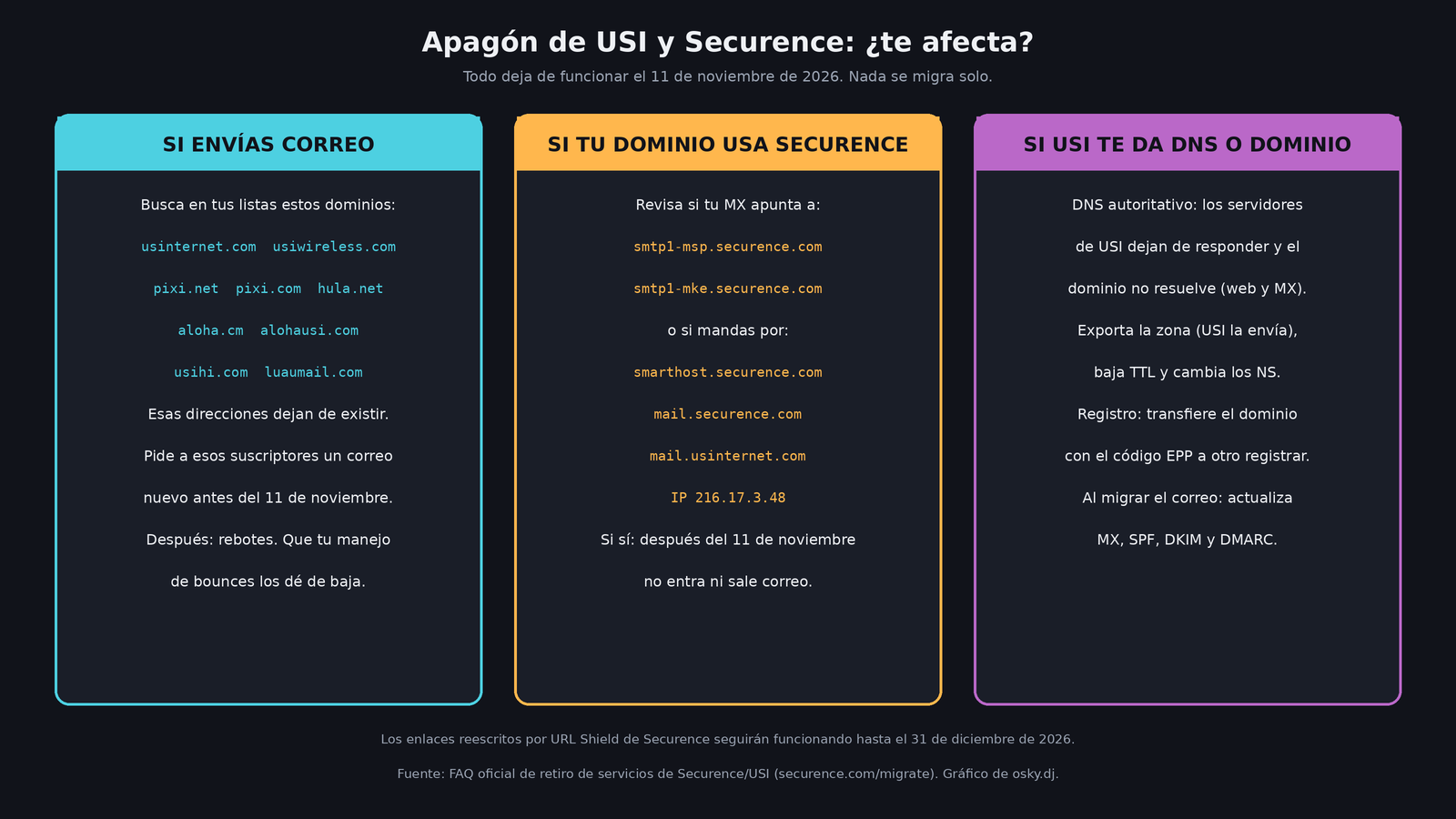
- usinternet.com and usiwireless.com
- pixi.net and pixi.com
- hula.net, aloha.cm, alohausi.com, usihi.com, and luaumail.com
USI recommends setting up forwarding to the new account right now from admin.securence.com, but warns that forwarding also dies on November 11. After that date, it says verbatim, messages to the old address "will no longer be delivered or forwarded."
Spam Resource adds a data point on scale: besides those consumer domains, the shutdown likely affects the more than 1,100 customer domains that Securence hosted, according to a registry of domains with MX at Securence from early 2026.
If you send email: clean up your lists now
Even if almost nobody in Mexico has a @pixi.net address, anyone who runs newsletters, transactional email, or a customer database with users in the United States should check their lists. Al Iverson's advice is clear: write to those subscribers now and ask them for a new address, because after November 11 you will be sending to mailboxes that are on their way out.
He also warns that providers don't always cut off inbound email on the same day, but that you should assume those addresses will start bouncing. In practice:
- Search your database for the nine domains on the list and separate them into a segment.
- Send them a notice before November 11 so they update their email.
- Check that your bounce handling removes addresses that fail instead of retrying forever. Mass bounces to dead domains don't help your sender reputation.
If your domain uses Securence or USI
Here the problem is more serious, because you're not losing one address: you stop receiving email on your entire domain. The FAQ explains how to tell if you're affected:
- Your MX records point to
smtp1-msp.securence.comorsmtp1-mke.securence.com. - Your systems send email through
smarthost.securence.com,mail.securence.com, ormail.usinternet.com(IP 216.17.3.48). - Your email clients use those servers for POP or IMAP.
- Your nameservers are USI's.
If any of these apply, you need to sign up with another provider and update MX, SPF, DKIM, and DMARC according to their instructions. Before the 11th, it's a good idea to export your allow and block lists and your user list from the panel, and to release quarantined email. For DNS, USI offers to email you the zone file and recommends lowering your TTLs before changing nameservers, because propagation can take up to 48 hours.
I haven't tested it; all of this comes from the official Securence FAQ and Spam Resource's analysis.
What this means
My take: it's another chapter of an old story. The email your internet provider "gives" you is theirs, not yours, and the day they decide to get out of the business they give you a few weeks to move out. Whoever had their own domain can keep their address by moving the MX records. Whoever used @usinternet.com loses the address forever, along with every bank account, password recovery, and two-step verification that was tied to it.
For anyone who runs systems, the lesson is twofold. First: your email and your DNS shouldn't depend on a provider that doesn't make its living from them. Second: ten days of margin is far too little to migrate a whole domain with filtering, archiving, and DNS. If any of your clients is in this situation, today is the day to call them.