
Today at 11 a.m. Mexico City time we lost email. We had no intranet either: it authenticates with Entra ID, Microsoft's identity platform, and only people who already had a session open could get in.
We weren't alone. Microsoft 365 had one of its biggest outages of the year: Outlook, Exchange Online, Teams, SharePoint, Copilot, even Defender. By mid-afternoon social media had already found the culprit: "it's an AI attack." I went to check what's behind that claim, because in infrastructure the difference between a rumor and a fact is exactly what decides what you do the next day.
What happened, in Microsoft's words
- 16:17 UTC (10:17 in Mexico City). Microsoft opens incident EX1550543: users unable to connect to their Exchange Online mailboxes "through multiple connection methods". Outlook on the web, the desktop app, mobile and the REST API. Every door into the mailbox.
- 17:54 UTC. First public notice on X. Thirteen minutes later they acknowledge it can affect "users in any region".
- 18:26 UTC. They open MO1550821 for the whole suite: Teams, SharePoint, Copilot, Defender XDR, Intune, Purview, Planner.
- Outlook peaks at about 129,000 reports on Downdetector around 1 p.m. Eastern.
The first explanation was "elevated load". Then Microsoft corrected itself, and this is the key sentence: "the elevated load isn't driven by an increase in traffic, but by a number of servers being unexpectedly unavailable; straining the remaining infrastructure". Later it added that those servers were failing automated health checks, that the problem might come from the component that processes those checks, that a process establishing secure connections was being overwhelmed, and that it would roll back a recent network configuration change that coincided with the start.
As I write this, Microsoft reports partial recovery, server by server, and the root cause in its incident record still reads "N/A".
Was it an AI attack?
There's no evidence of that. Microsoft hasn't reported malicious activity, and everything it has published describes an availability failure: servers dropping out and the remaining ones drowning. The "AI agent swarm" theory was born in forums, without a single source.
It's also not true that "Google, AWS and Cloudflare went down too". Their status pages reported no incidents. On Downdetector they gathered about 1% of Outlook's reports, starting 38 minutes to an hour later. It's the usual echo: when something big goes down, people report everything they have open.
So why did everyone believe it? Because the stage was set. On October 21, researchers working with AI models found PHP2Shell, two critical PHP vulnerabilities that had been hidden for years. Governments, banks and airlines took their sites offline to patch, CISA called for immediate action and a few days later confirmed active exploitation. After something like that, "it was AI" sounds plausible for anything. Sounding plausible doesn't make it true.

How a health check takes down healthy servers
This is the part that interests me most as someone who runs infrastructure, because it explains how an outage with no broken hardware, no attack and no traffic spike can last a whole afternoon.
A service the size of Exchange Online doesn't run on a server. It runs on entire fleets behind load balancers, and the load balancer needs to know where to send each request. So every few seconds it asks each machine whether it's healthy. If it doesn't answer correctly, it stops getting traffic. On a normal day, that rule is why you never notice a dead server.
The trouble starts when the check is the one that's wrong.
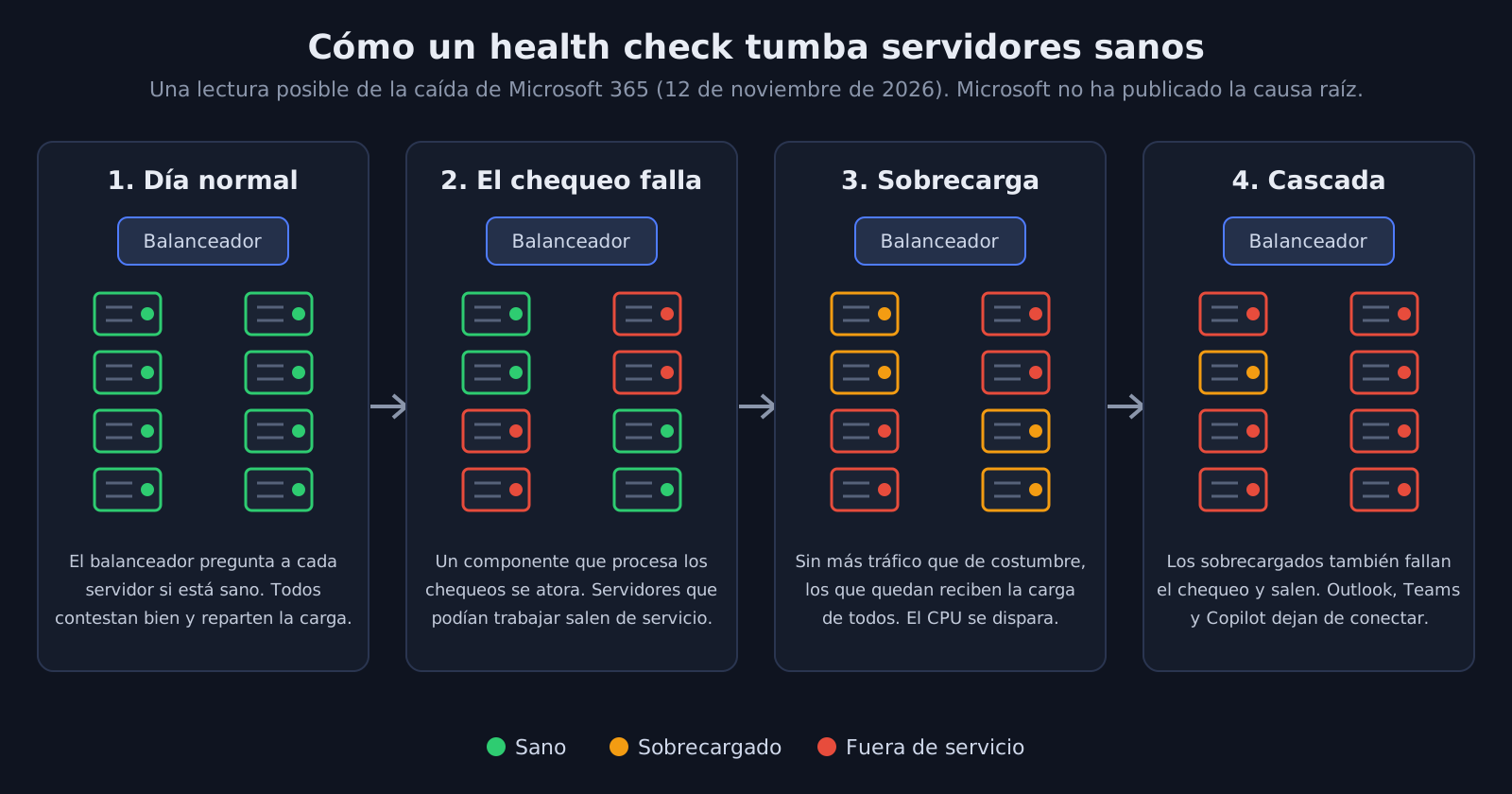
If the component that processes the checks gets stuck, servers that could still work are pulled from service. Their load spreads across the rest, which get overloaded, start answering slowly, fail their own checks and get pulled too. It's a cascade that the automation pushes on its own. Amazon puts it well in its guide to health checks: if automation removes servers from service when they still could have performed useful work, it does more harm than good.
To be clear: this is one possible reading of what Microsoft has published, not its confirmed root cause. The post-incident report will say whether it was this, the network configuration change, or a combination.
What it left us with
What struck me most was the intranet: whoever already had a session kept working, and whoever tried to sign in was locked out. It's a reminder that when you delegate identity to a provider, its outage is your outage too, even if your own server is perfectly fine.
What I'm taking back to my own systems:
- A health check shouldn't be able to shut down the whole fleet. Set a limit: if more than a certain share of servers "fail" at the same time, the check is probably what's broken. In that case it's better to keep sending traffic (fail open) than to pull them all.
- The status page can't depend on what went down. Microsoft had to post updates on X. If your monitoring and alerts live on the same infrastructure they watch, they go down together.
- Have a channel outside Microsoft 365 to coordinate when it goes down. If your whole team lives in Teams and Outlook, the day they fail there's nowhere to even say "it's down".
- Email doesn't get lost. The incident hit mailbox access, not SMTP delivery. And when a server refuses a message, the sender retries for hours or days. Before you resend everything, wait for the queues to catch up.
- Phishing follows every outage. This week there will be emails saying "your mailbox has been restored, sign in again". Users don't need to do anything. And nobody should relax MFA or conditional access "until it's fixed".
What we still don't know
Microsoft hasn't said why the checks started failing, or whether this incident is related to the Exchange failure on November 6, which also left mailboxes unreachable in North America. When it publishes its report, I'll update this post. Meanwhile, my advice is the usual one: before you share the culprit, find the source.
Sources
- BleepingComputer: Massive Microsoft 365 outage disrupts Outlook, Teams, Copilot worldwide
- SecurityWeek: Microsoft 365 Outage Disrupts Outlook, Exchange Online and Teams
- Al Jazeera and Reuters: Microsoft outage hits tens of thousands of users
- ThousandEyes: Microsoft 365 Outage Analysis, November 12, 2026
- Enrow: timeline, cause and what happened to the emails
- Microsoft 365 Status on X
- World Economic Forum: the PHP2Shell shutdown
- Amazon Builders' Library: Implementing health checks