On November 12, 2026, Google introduced Gemini 4 Hydrogen, the third model in the Gemini 4 family after Carbon and Argon. It's not the smartest model in the house and doesn't try to be: Google is selling it as the "everyday" model for coding and agents, fast and cheap, and it also slipped it in as the engine of Search for all users. For anyone building with the API, the practical news is something else: Hydrogen is the recommended replacement for Gemini 3.8 Flash, and the migration brings changes that can break code that works today.
What Hydrogen is and where it fits
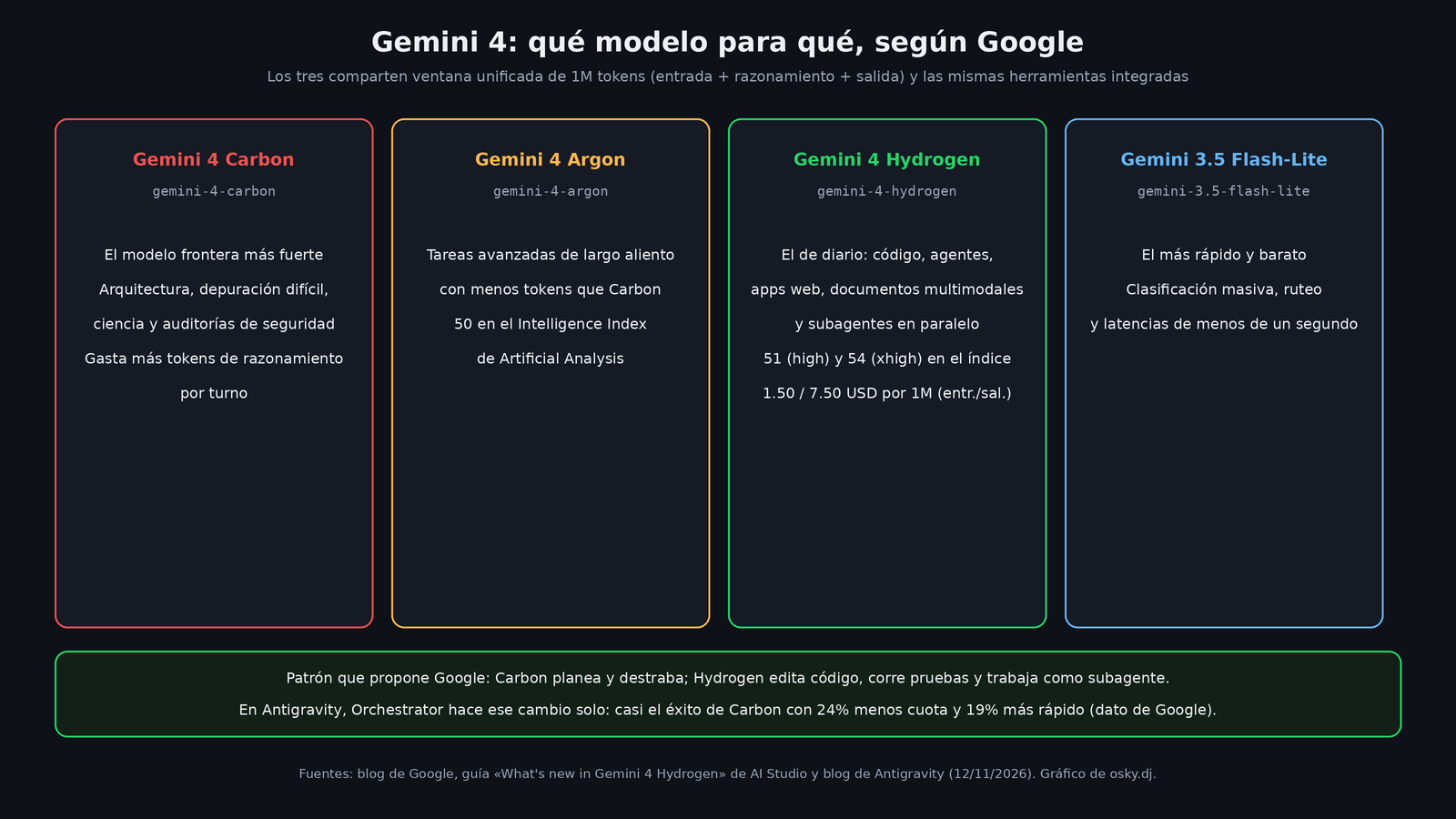
According to the announcement by Koray Kavukcuoglu, senior vice president at Google DeepMind and Google's chief AI architect, Carbon and Argon are meant for deep, long-horizon reasoning, while Hydrogen is built for "fast execution" in agent workflows: writing code, running tests, verifying changes. The AI Studio developer guide makes it even clearer by assigning roles:
- Carbon (
gemini-4-carbon): the strongest frontier model, for architecture, hard debugging, science and security audits. - Argon (
gemini-4-argon): advanced long-horizon tasks using fewer tokens than Carbon. - Hydrogen (
gemini-4-hydrogen): everyday code, web apps, agents with tools, multimodal documents and parallel subagents. It's the recommended upgrade from 3.8 Flash and the earlier Gemini 3 and 2.5 models. - Gemini 3.5 Flash-Lite remains the fastest and cheapest, for mass classification and routing.
The numbers Google is bragging about: on the Artificial Analysis Intelligence Index, Hydrogen scores 51 at its default reasoning level, one more than Argon (50), and reaches 54 at the highest level. Against 3.8 Flash, Google says it finishes tasks 2.5 times faster, goes from 18.2% to 57% on Terminal-Bench 4.1, and cuts made-up claims by more than five times. All of those are the vendor's figures; independent measurements will take a few days to arrive.
Pricing and specs
The official table puts the paid price at 1.50 USD per million input tokens and 7.50 USD per million output tokens, flat across the entire context window. That window is 1,048,576 tokens, unified: input, reasoning and output all come out of the same pool. A single request delivers up to 65,536 tokens; for longer responses you have to use background execution (background: true), which keeps generating in 64K chunks until the window is full.
Hydrogen has four reasoning levels: low, medium, high (the default) and xhigh, which is new. Google recommends starting at high, saving xhigh for hard multi-step problems because it burns more tokens and "may overthink" simple questions, and sticking with the lowest level that passes your tests. The model is available on the free and paid tiers of AI Studio and the API.
Migrating from 3.8 Flash: what breaks
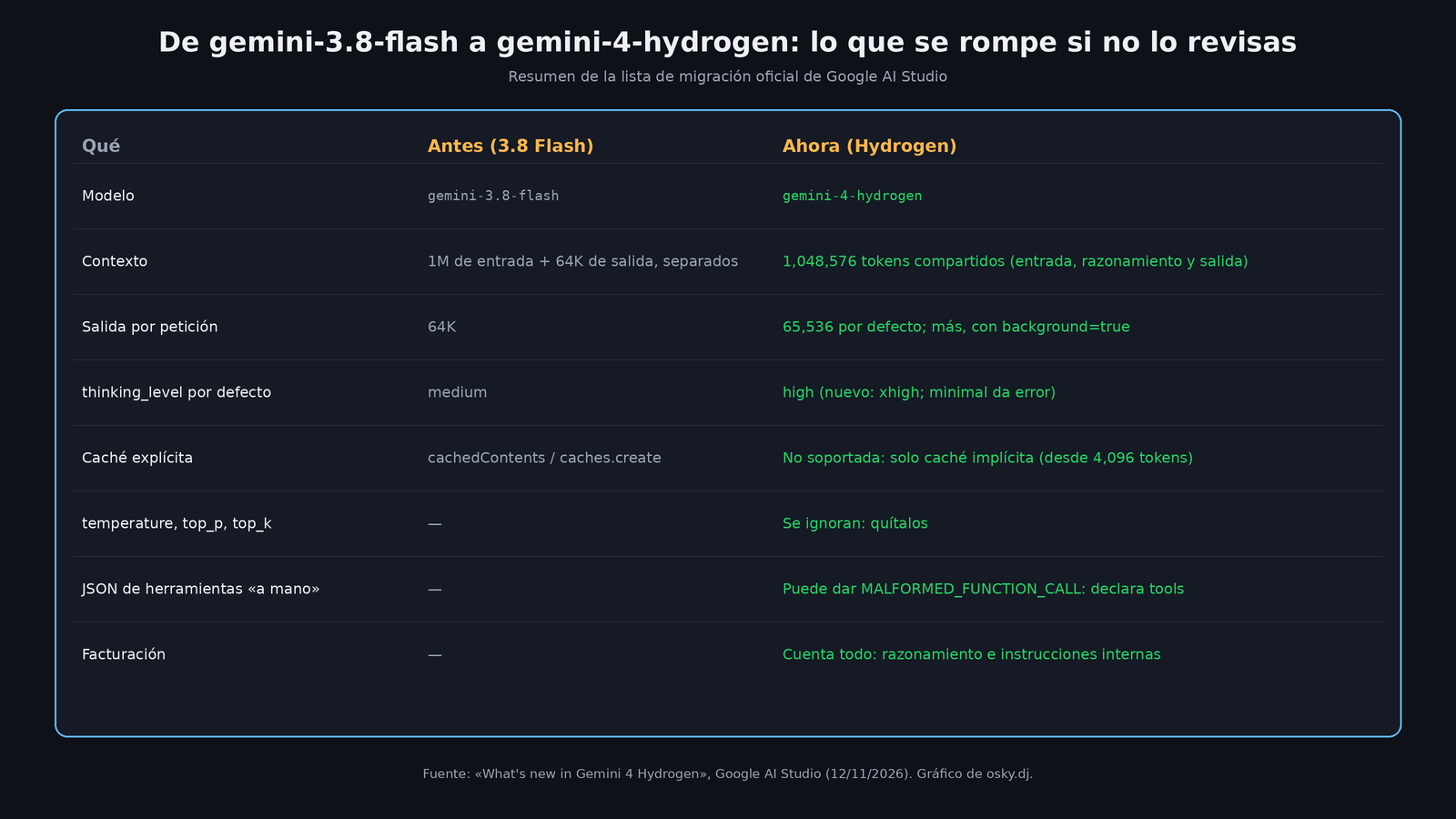
This is the part you need to read before changing a single line in production. Google's migration list says it's not enough to swap gemini-3.8-flash for gemini-4-hydrogen:
- Context is no longer split. 3.8 Flash had 1M input and 64K output separately; Hydrogen shares the million across everything. Google asks you to remove any low hardcoded
max_output_tokenscaps (like 8,192) or raise them to 65,536, because that cap now includes reasoning. - Default reasoning goes up from
mediumtohigh, and theminimallevel now returns an error. - Explicit caching is gone.
cachedContentsandcaches.createare not supported; what's left is implicit caching, which kicks in automatically from 4,096 tokens and gives a 95% discount on hits. temperature,top_pandtop_kare ignored. The server doesn't honor them even if you send them.- Declared tools, not improvised ones. If you use system instructions to make it spit out tool JSON without declaring any tools, it may return
MALFORMED_FUNCTION_CALL. You have to use native function calling or structured outputs. - Everything is billed: reasoning tokens, internal grounding instructions and function declarations.
If you already use Carbon or Argon, moving to Hydrogen requires no changes to the request schema, according to the same guide. Also, the Antigravity agent in Gemini Managed Agents already uses Hydrogen by default.
Orchestrator: two models in a single session
In Google Antigravity, its agent-based coding environment, Hydrogen arrives alongside Orchestrator, an option in the model picker that alternates between Carbon and Hydrogen within the same task. Carbon explores and builds the plan, Hydrogen writes code, updates packages and runs tests, and if it gets stuck it hands control back to Carbon. Google says this achieves nearly the same success as Carbon alone, with 24% less quota and 19% faster. One detail: the main blog attributes that figure to Terminal-Bench 4.0 and the Antigravity one to 4.1.
In Antigravity, Hydrogen is available to paying Google AI Pro and Ultra subscribers. Orchestrator arrives with Carbon and Argon for Ultra, and only with Argon for Pro.
Hydrogen in Search
On the consumer side, Robby Stein, vice president of product for Search, called it "the biggest model upgrade" Search has had. Google says Hydrogen is already available to all users worldwide and that it better understands multi-part or misspelled questions, expands the query fan-out technique (launching simultaneous searches by subtopic) to show more links, and responds with more images, comparison tables and custom tools. According to Hipertextual, you select it with the "+" button under the search box and it may take a while to show up.
In the Gemini app it appears in the model picker; free users get it through automatic selection, when the system decides it's the right fit for the question.
Safety, according to the model card
Google claims Hydrogen reduces overreach in agent tasks by up to 81% compared to 3.8 Flash, is up to two times less likely to bypass permission limits when a task is blocked, and resists indirect prompt injection 2.3 times better on the Gray Swan IPI benchmark. The details are in the model card.
My take
What's interesting here isn't 51 versus 50 on an index; it's the price and the work pattern. Google is openly pushing the idea that nobody should use the most expensive model for everything: one big model that plans and one cheap model that executes. For a bot or an agent that currently runs on 3.8 Flash, Hydrogen promises better quality, but the cost change depends on the reasoning level you choose: with high as the default and reasoning billed, the bill can go up even if the per-token price looks reasonable. Before migrating, it's worth running your real cases at medium and high, checking your output caps and removing explicit caching. And watch out if you depend on Google traffic: a search engine that answers with its own tables and tools is, once again, a search engine that sends you fewer visits, even if Google promises "more links".
Sources
- Introducing Gemini 4 Hydrogen (Google, official announcement)
- What's new in Gemini 4 Hydrogen (Google AI Studio, developer guide)
- Google Search gets a major upgrade with Gemini 4 Hydrogen (Google)
- Gemini 4 Hydrogen and Orchestrator (Google Antigravity blog)
- Gemini 4 Hydrogen: everyday coding and agentic workflows for developers (Google)
- Gemini 4 Hydrogen model card (Google DeepMind, PDF)
- Google launches Gemini 4 Hydrogen and integrates it with its web search engine (Hipertextual)
- Hacker News discussion