On Tuesday, November 24, 2026, Quad9, the free public DNS resolver at 9.9.9.9, stops serving users located in France. This is not an outage or a budget cut: it is the exit the Swiss foundation chose so it would not have to obey a court order requiring it to block domains accused of pirating sports broadcasts. On November 17, Cloudflare dedicated an entire post to the case and called it "the canary in the coal mine." For anyone who runs servers, networks or devices with a hardcoded resolver, the case offers two lessons: the public resolver you set "just because" can disappear for legal reasons, and the pressure to turn resolvers into content filters is no longer just a French thing.
What happened
According to Quad9's announcement, published on October 22, a French court ruled a day earlier in favor of beIN, the Qatari sports broadcasting company with offices in France. The ruling requires Quad9 to stop resolving a list of domains for users located in France. The court reduced the penalty from 580,000 euros to 1,000 euros per day of non-compliance, but Quad9 says this is not about money but about principles: "we categorically refuse to alter or lie" to its users about DNS responses.
The problem is not just this one lawsuit. Quad9 says it has about 20 more cases pending in France, against it and other resolver operators, asking to block hundreds of names. Its calculation is that if each one ends in daily fines, the foundation does not survive. That is why it announced its exit from the country starting November 24, while it appeals the ruling.
Why not just block
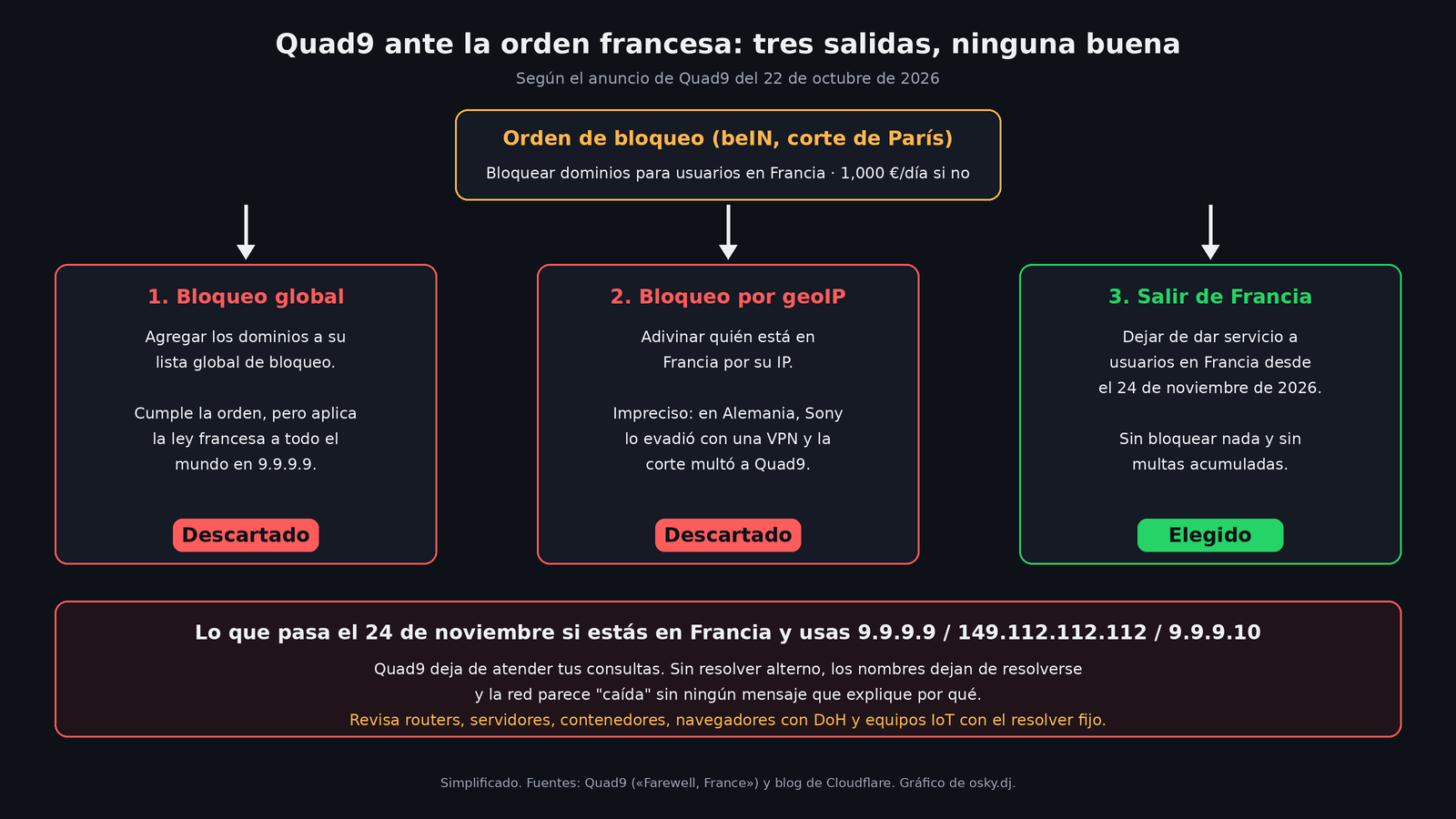
Quad9 explains in its announcement that it had three paths, and two of them were not viable:
- Global blocking. It could add the domains to its malware and phishing blocklist, the one applied to all 9.9.9.9 users worldwide (not to the unfiltered service, 9.9.9.10). That would comply with the order, but it would apply a French court's decision to the entire planet, for the benefit of a private company. Quad9 rules it out because it would open the door for any country to impose its laws on the rest through DNS.
- Blocking by IP geolocation. Quad9 keeps no user records and does not know who is French. Besides, it already tried this in Germany: in the case against Sony Music (2021 to 2023) it used geoIP as a patch, Sony accessed the content from Germany using a VPN, and the court fined Quad9 for contempt. In the end it won that case, but it cost several years and "six figures."
- Leaving. It is the only option that, according to Quad9, eliminates the legal risk without betraying its mission.
Who this hits
More people than it seems. In its announcement, Quad9 published a partial list of French networks it receives traffic from, identified by autonomous system number: the government's digital directorate (DINUM), the RENATER academic network, EDF, SNCF, the Marseille public hospital group (AP-HM), France Télévisions, Thales, and regional and municipal governments, among many others. It says it picked those at random and that there are hundreds more.
Cloudflare sums up the practical risk: since Quad9 does not store data on who uses its service, it has no way to notify them directly. If someone does not change their resolver before the 24th, their internet will simply stop working with no explanation. Cloudflare specifically mentions devices that ship with Quad9 hardcoded in their configuration, such as security systems or thermostats, where the fix can be slow or impossible.
There are also second-order effects. Mullvad warned people using Mullvad Browser in France with Quad9 as their DNS over HTTPS provider that they need to change it. And it clarified that nobody outside France is affected: Quad9 will reject queries coming from that country.
It's not an isolated case
Cloudflare's post places Quad9 in a line that keeps getting longer:
- Cisco had already withdrawn OpenDNS from France, Portugal and, temporarily, Belgium, in similar circumstances.
- In Belgium, an order obtained by DAZN requires Cloudflare, Google and Cisco to block sites on their public resolvers (1.1.1.1, 8.8.8.8 and OpenDNS) by early January 2027, under threat of fines. Cloudflare says that, together with Google and Cisco, it appealed that order. According to Lawyerd's analysis, the penalty is 100,000 euros per day on match days only, capped at 20 million per company, and the list went from 58 domains to 258.
- In France, Cloudflare did win a round: on September 17 a Paris court rejected the fines Canal+ was asking for because Cloudflare complied by blocking on its CDN and not on 1.1.1.1, as TorrentFreak reported. Cloudflare states it has never blocked content through 1.1.1.1. Quad9, which only operates a resolver, did not have that card to play.
- The EFF warns that in the United States Congress is considering several site-blocking proposals that would also reach DNS resolvers.
The technical argument repeated by Quad9, Cloudflare and the EFF is the same: blocking at the resolver does not remove the content from the internet. Anyone who wants to watch the pirated match switches DNS in a minute, or goes straight to the IP. The only thing lost is a privacy and malware protection service for millions of users who have nothing to do with piracy.
What this means if you run infrastructure
My take: even if your servers and your users are not in France, this is a good time to take inventory. How many times have you typed 9.9.9.9, 1.1.1.1 or 8.8.8.8 "just to make it work" in a resolv.conf, in a Docker configuration, in a netplan, in a router, or in the firmware of some device nobody remembers the location of. What used to be a technical dependency is now also a legal dependency.
A few practical recommendations. These are general rules of thumb, not something I have tested against Quad9's cutoff:
- If you have devices, customers or offices in France, look for Quad9's addresses before November 24. According to its service page, they are
9.9.9.9and149.112.112.112(with malware filtering),9.9.9.10and149.112.112.10(unfiltered),9.9.9.11and149.112.112.11(with ECS), their IPv6 equivalents under2620:fe::, and the endpointsdns.quad9.net,dns10.quad9.netanddns11.quad9.netfor DoH and DoT. - Don't depend on a single operator. If you configure resolvers by hand, set another provider's as a fallback, not just the secondary address of the same one. If the operator leaves your country, both go away.
- Watch out for browser DoH and IoT devices. Those are the places where the resolver tends to be hardcoded and nobody checks it.
- If you sell devices or software with a default resolver, make sure it can be changed without updating the firmware.
The other takeaway goes deeper. The "neutral" public resolver is becoming a service with borders. The big ones, like Google and Cloudflare, have lawyers and other products to negotiate with; a nonprofit foundation with a single product does not. If the trend continues, many people's default resolver will go back to being the ISP's, which is precisely the easiest one to force into filtering and to monetize. Quad9 says the decision is reversible and that it hopes to return if the law changes. For now, on November 24 it goes dark.
Sources
- Farewell, France, Quad9 announcement (October 22, 2026)
- Service Addresses & Features, Quad9
- Quad9's withdrawal from France: A canary in the coal mine, Cloudflare blog
- Quad9 will withdraw their DNS service from France, Mullvad
- French Court's Site-Blocking Orders Drive Quad9 Out Of France, EFF
- Cloudflare Keeps 1.1.1.1 Out of Piracy Blocking, Escapes Penalties in France, TorrentFreak
- Belgium DNS blocking upheld: DAZN v Google, Cloudflare, Lawyerd